

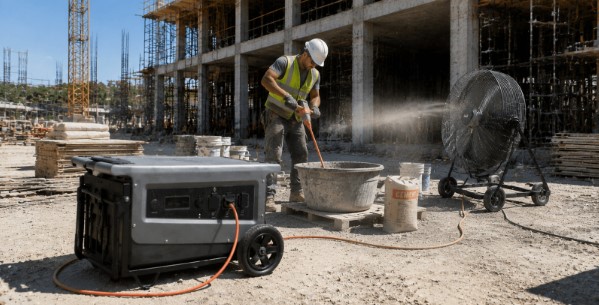

Maintaining equipment operational in construction sites has always been challenging. Dust settles on every piece of equipment, cables create tripping hazards, and diesel generators have fuel needs that must be met by trucks, while the rain may bring the job to a halt faster than a delay in materials delivery. Anyone who has supervised a construction site during the tropical monsoon or winter in northern regions understands that electricity is not just a luxury but a necessity. It makes a difference between completing the project on time and telling the client that the pouring of concrete has been postponed for another week.
Reasons like this have led to the gradual transformation of portable generators into some of the essential devices in the construction industry. Initially viewed only as an accessory for casual walkers, power banks have evolved into a viable solution for industrial power consumption.
Why Job Sites Need Something Better Than a Diesel Generator
Machines that use diesel energy have already shown to be preferable in many instances due to numerous advantages. The logistics problems referring to the storage of the fuel, its transportation and refueling are present continuously in the areas with hard-to-reach places or areas subjected to exposure. Apart from that, generators create pollution and health problems for operators operating at places that are either closed or semi-closed.
A power source of the Industrial Power Station kind is a game-changer.Instead of depending on fuel as a resource at the working location, it uses electrical power stored in batteries that are huge enough to be charged by power grid, sun rays, or engine operating at full capacity instead of idly recharging the power needed to use different tools from time to time.
The contract workers using machinery will appreciate the fact that this power source works quite silently, does not produce any unpleasant smells, and does not involve situations with fuel abuse which can interfere with their routine working process. The capacity of the battery bank is only one of the things that distinguish these devices from the regular ones. The big battery bank is actually an advanced power bank for consumer use. It has such useful features as constant duty output, possibility to charge several devices at the same time, and heavy duty housing.
The Water Problem Nobody Talks About Enough
While guides and salespeople can be helpful in choosing a power station, one point can easily confuse the buyer: most of “heavy-duty” power stations are only resistant to drops and dust or to water and drops, while only some of them are truly waterproof. Moreover, it is again water that is often responsible for the premature breakdown of construction machines. Rain keeps on pouring. Concrete works are always performed in the presence of water. Roofing or any other outdoor job must be done in conditions that no producer would find acceptable. A Waterproof Power Station pays itself back. The weatherproof devices that are manufactured at a certain level of its protection level IP enclosed in waterproof housing are those instruments which you can continue using in case of unfavorable weather, intense rainfall and/or extreme wetness that may be present on your jobsite for as long as one week or more. In fact, it results in less downtime, less damage to equipment and, finally, the least amount of stress for the site manager, who used to check the weather forecast just as thoroughly as he checked the threat assessment.
The only thing that should be taken into account is the abuse of the term “waterproof” in advertising. The unit which can be trusted for occasional water splashes is quite different from the one which should sustain real downpour on the ground without shelter. That is why one should consider the meaning of the word “waterproof” as well as the specific IP rating of the unit before purchasing the site power equipment.
Solar, Batteries, and the Push Toward Sustainable Sites
The construction industry is one of the slowest fields to adopt green practices, probably due to the process nature, which is very material consuming. While it is not possible to set up a 3D printer for a highway overpass, there are areas within the power field that adopt innovations rather promptly, and this decision is based not only on innovative tendencies but also on economic profit.
Fossil-free power stations combined with portable solar units provide construction teams with opportunities to generate a big part of energy right on the job site. Solar electrical systems are the right fit for both locations with a lot of sunshine and long working hours typical of construction sites in summer. Even in cases when the solar system is not able to fulfill the total energy needs, the combination of charging batteries from the power grid during the night with the possibility to use solar energy during the day helps to save a considerable amount of diesel fuel.
One more benefit of battery systems is that they are much easier to operate. All that is required is to monitor the battery, without changing lubricants, inserting filters or checking other engine conditions. For the supervisor
What to Actually Look for Before Buying
Anyone interested in purchasing a power station for a building site should avoid picking one based on how many amps it supposedly produces. As far as practical application is concerned, only two or three factors really matter:
- Type of output and load at the same time. Construction devices consume electric energy as bursts of power. It is not enough that the device can be a powerful one. It should also be able to handle surge currents without malfunctioning or overheating.
- Ingress protection. Read above and look for IP rating instead of vague statements about “being waterproof”.
- Charging capability. Good power stations can be charged not only from the mains but also from the car generator and solar panels, which gives construction teams peace of mind when one of the options is not available.
- Capacity and portability trade-offs. Bigger battery means more runtime, but heavier and larger. A mid-sized unit with maximum portability that can be moved from location to location might be more useful to a site that has restricted access or that you need to relocate frequently, than a large unit that waits neglected in the corner.
Looking Ahead
There have been minimal changes in the construction industry, indicating that diesel generators will still be present on construction sites for some time now. In this context, the following trend can be observed: the decrease in battery prices and an improved production process have transformed portable power stations into versatile equipment, which can be used for day-to-day purposes rather than having to rely on them only in case of emergencies.
For those construction companies which are thinking of getting new equipment, the situation seems to be straightforward: less logistics involved in terms of fuel supply, noise reduction, and downtime elimination are things that can be offered to customers.